Showing posts with label privacy. Show all posts

Monday, August 16, 2010

Company forums, personal information and the World of Warcraft

Those of you who have forums on your Web site understand that spammers and trolls can be a real nuisance. Perhaps you can relate to the trouble Activision Blizzard has with dealing with the multitude of undesirable posts on their official World of Warcraft forums.

On July 6th, Activision Blizzard, Inc. unveiled a controversial plan to help regulate the forums: Anyone posting on forums would have their real name displayed. The philosophy is that with real names associated with each posting, personal accountability will come into play and subscribers will be more civil. There was immediate backlash from WOW subscribers and users concerned about this proposed policy change. Personal privacy advocates were particularly concerned about publicly displaying real names in connection with Warcraft. Posters also worried about the possibility of cyberstalking and out-of-game harassment.

In an attempt to show how "harmless" the proposed change would be, a forum moderator posted his real name in the Blizzard Forum discussion on this topic.
Within minutes, community members posted all matter of personal information on him. Using only Google searches and his real name, they found and posted such info as his:

  • Cell phone number
  • Twitter and Facebook accounts
  • Personal photos
  • Mailing address
  • Maps to his house.
The community used this opportunity to illustrate how much information can be easily gathered, and how it could be dangerous when your real name is displayed in the forums.


There are simpler ways to combat undesirable posters than by publicly displaying personally identifying information. In her post, forum moderator Nethaera provides the basic methods used in forums to ensure that useful information will be seen and found by users:
  • Having the community rate posts (the Slashdot commenting model)
  • Highlighting posts based on rating (YouTube's "highest rated comment" model)
  • Improving forum search

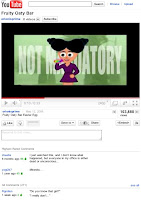
    YouTube has successfully adopted most of these methods to improve the comments on their videos (highest rated comments, voting up/voting down and automatically hiding spam/comments with a low rating).
The lesson is that spammers and trolls will make it on to your company forums, as they find their way onto EVERY board. The undesirable posters can manage to defeat almost any automated security precautions you can set up. The presence of an active group of forum moderators (employees of your company or a trusted enthusiast of your brand) goes a long way to creating an active, safe community. Even though forum trolls and spammers are a nuisance on forums, you do not need to take the drastic measures of posting your customer's personal information to combat them.

-by Kyle Kulakowski

Thursday, November 19, 2009

Who exactly is taking my money? Poor usability = reduced online sales

It's ironic that online check-out - the point in ecommerce at which users are most sensitive - is the point where many Web sites fail to provide the brand consistency that users need to feel confident about entering personal information and credit card numbers.

Abrupt interface changes (from the main Web site to the ecommerce application) are the most common - and most destructive - usability problems on ecommerce sites. A startling new interface with different branding, combined with a new URL, will give pause to any user, regardless of technical literacy. They wonder: Am I on a different site? Is the privacy policy different? Who exactly is taking my money?


When someone decides to purchase from your Web site it's because they trust you and your brand. Our own research and usability testing has shown scores of users halting and not completing transactions when they encounter an unfamiliar screen at the point of interaction.

What caused this problem? Initially, many Web sites
did not have ecommerce functionality, so it was bolted on as an afterthought. Third-party applications were used as the ecom stopgap. Brands were not allowed to customize these interfaces. The result: A bumpy ride for the user, reduced sales for the company. See examples below of the inconsis

The solution: Bring ecom under your primary Web property so users trust you - leading to increased online sales. Plan for ecommerce within your information architecture.

Example of a third-party payment system

Clicking on conEdison's "Pay by credit card" option takes you to a third-party company that handles the payment. The transition is jarring for several reasons:
  • New URL doesn't mention conEdison
  • NCO logo replaces conEdison's in the upper left
  • New color scheme
  • New privacy statement.
The payment agency does responsibly provide a link to their own privacy policy and disclaimer that they are a third party that handles payments. Yet, other than the inserted conEdison logo, it's difficult to tell that this page relates at all to conEd's parent site.

Thursday, November 5, 2009

Privacy policies: Impacting conversion and online sales?

The last few years have yielded discussions of the role of text in interface, or text as interface. Stepping away from conventional interface design for a moment, we applied the principle of text as interface to an evaluation of the privacy policies on Amazon.com and Yahoo.com.

What did we find?
We learned that Amazon's privacy policy is highly specific about the type of information it harvests about its users, whereas Yahoo glosses over much of the same information. The end result is the appearance of a lack of transparency on the part of Yahoo, compared to Amazon's extremely specific and open policy statement.


Why does this matter?
Our usability studies have shown that privacy policies and clarity of how well they're stated directly impacts a user's likelihood to complete an interaction.
Amazon and Yahoo both admit to collecting the following information:

  • Email address
  • Login, name and password
  • Cookie information
  • Address
  • Occupation
  • Social Security number
  • Personal descriptions/interests
  • Software and hardware attributes
  • IP address

What else is collected?
Yahoo remains vague, whereas Amazon specifies that the following information is collected and why:

  • Computer and connection information such as browser type, version, and time zone setting
  • Browser plug-in types and versions, operating system, and platform
  • The full Uniform Resource Locator (URL) clickstream to, through, and from our Web site, including date and time
  • Content of reviews and e-mails to us
  • The phone number you used to call our 800 number
Who else gets my information?
While both companies state that your information is shared with third parties and trusted partners, only Amazon lists names, which include:
  • Target
  • CD Now
  • Verizon Wireless
  • Sprint
  • AT&T
Google Dashboard - a move in the right direction

Google DashboardGoogle's announcement today of Google Dashboard is a start in creating greater transparency. It allows you to view and manage information that Google is currently capturing. For example, you can view privacy policies and manage setting for all your Google accounts such as Blogger, GMail and Chat, view which of your data is private and which is visible to others, and remove items from your Web history.

We at Interface Guru encourage you to make use of tools and services that openly declare their usage of your personal data. Facebook's lack of transparency has been a recent hot topic - and rightfully so. Stand up for your digital rights!

Tuesday, October 27, 2009

The GOP Facebook Friendship Fairness app: Funny, or scary?

The new GOP.com has been thoroughly "reviewed" by the likes of Jon Stewart, who of course has comments outside the domain of this blog. The feature that captured my attention was the so-called Facebook Friendship Fairness app. From the site:

"How much longer will it be before you get the following notice from the new "Friendship Fairness Czar?

"Official Notice of Violation and Assessment of Friendship Tax:

"An audit of your Facebook account shows that your total number of friends is above the average of 120 friends for all Facebook users. The Friendship Fairness Czar has determined that you have an excessive and unfair number of friends and has devised a solution to spread the wealth of friendship. Please click on the Friendship Fairness Czar Facebook Application to be assessed your tax and become a fan."

Now, I know this entire site is attempting to present - literally - a new public face for the Republican National Committee. If that is the case, do they really want to lead off the Facebook initiative with the implication that they have snooped your Facebook account?

Privacy came to the fore in the last few years as social media collided with the "War on Terrorism." My take: If the RNC wants to create a new perception of itself - and this slick Web site starts to move it in that direction - maybe joking about privacy isn't the best way to go.

Just a thought.

Thursday, September 3, 2009

Why it's crucial for social networks to make privacy obvious

In today's Science Daily: Many Online Social Networks Leak Personal Information To Tracking Sites, New Study Shows. Science Daily does an excellent job of explaining the technology; our usability studies show that users are acutely aware of being "tracked" in some way. This is as true of the 13-year-old "digital native" as it is of older late-adopters. If you want people to adopt your social network, you MUST declare privacy policies - particularly at interaction points such as registration fields and profile set-up forms.Kudos as always to Science Daily.

When FREE is a lie - personal info and privacy, astrology.com


Back to my favorite (of late) whipping boy, astrology.com: This iVillage site should not assume its loyal readership will stick around. The outdated visual design now suffers even more from intrusive advertising that I close immediately (if a popup). The term FREE on "today's three special offers!" is deceptive, because as soon as you click through, you will see it -is- FREE - but you must submit personal information, which these days is worse than asking for money. How many people exit the transaction at this point? iVillage, are you looking at your stats?

Word on the street is that astrology.com is about to face some stiff (and contemporary-looking) competition. Time to review metrics, conduct usability testing, and redesign this very outdated interface. I visit regularly and it seems someone has decided to experiment with varying placement of elements on the home page.

Other problems on astrology.com: No dates on items like Tarot readings. If today's cards are the same as yesterday's, why should I trust the site?

In closing: Clicking through to the Numerology offer, which requests full name at birth and full name used today, as well as email, does not offer a visible privacy policy. Oh, and the browser window titles don't match the pages.

iVillage's success with this site is at risk.